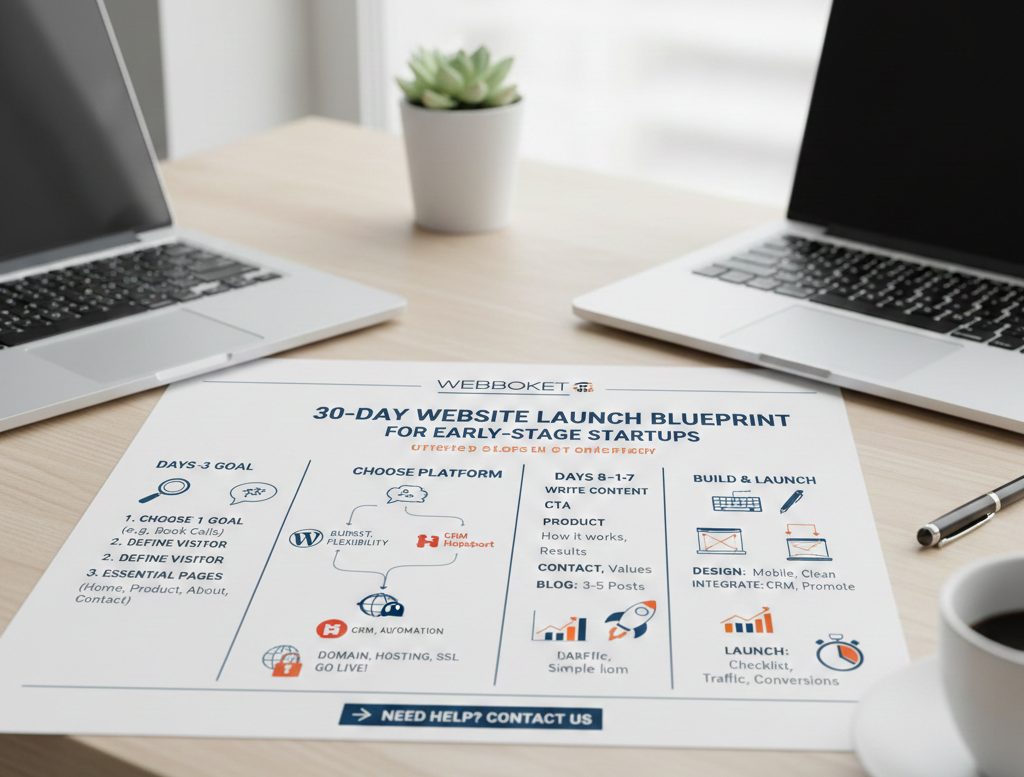
A 30-Day Website Launch Blueprint for Early-Stage Startups
Launching a startup website often takes far longer than it should.
Founders know they need a professional website that explains their product, builds credibility, and generates leads—but weeks pass choosing themes, tweaking copy, or debating between WordPress and HubSpot CMS.
Instead of becoming a growth asset, the website becomes a blocker.
At Webbuket, we help early-stage startups and growing companies launch conversion-focused websites and scalable digital experiences. As HubSpot CMS experts, WordPress developers, and digital marketing specialists, we’ve seen one truth repeatedly:
A clear website launched quickly always outperforms a “perfect” site that never goes live.
This 30-day blueprint shows how to go from zero to a live, lead-generating startup website—without overengineering. It works whether you choose HubSpot CMS or WordPress and prepares your business for future growth with CRM, automation, and digital marketing.
Days 1–3: Define the Goal of Your Startup Website
Step 1: Choose One Primary Website Goal
Before design, tools, or development, answer this:
What is the single most important job of your website for the next 3–6 months?
Common goals for early-stage startups:
-
Capturing qualified leads
-
Booking discovery calls or demos
-
Building a beta or waitlist
-
Establishing credibility with investors or partners
Write one clear sentence, such as:
“Our website’s job is to get early-stage B2B founders to book a 20-minute discovery call.”
This focus keeps your startup website launch fast, simple, and measurable.
Step 2: Define Your Ideal Website Visitor
Skip long persona documents. You only need clarity on:
-
Who they are (role, industry, company size, startup stage)
-
Their main problem related to your solution
-
What success looks like for them
-
What concerns or objections they have
-
Why they might hesitate to contact you
This is the foundation of conversion-focused website design and effective digital marketing for startups.
Step 3: Start With Only Essential Website Pages
At launch, most startup websites only need:
-
Home – Clear value proposition and next step
-
Product / Service – What you offer and how it helps
-
About – Who you are and why you’re credible
-
Contact / Book a Call – Simple way to reach you
-
Blog (optional) – A few trust-building posts
You can expand later using real data—not assumptions.
Days 4–7: Choose the Right Platform for Your Startup Website
Step 4: HubSpot CMS vs WordPress for Startups
You don’t need a complex tech stack early on. Use this rule:
WordPress is a good fit if:
-
Your budget is limited
-
You want maximum flexibility and plugins
-
You’re okay managing hosting, updates, speed, and security
HubSpot CMS is ideal if:
-
You want website + CRM + forms + email in one system
-
You care about inbound marketing and sales alignment
-
You want full visibility from visitor → lead → customer
At Webbuket, we often recommend HubSpot CMS for startups focused on scalable growth. For simpler or content-driven needs, WordPress websites for startups work well.
Quick summary:
-
Simple, DIY startup website → WordPress
-
Growth-focused, CRM-integrated website → HubSpot CMS
Step 5: Set Up the Website Essentials
Domain & Hosting
-
Connect your domain (yourstartup.com)
-
WordPress: choose reliable hosting with SSL and backups
-
HubSpot CMS: use HubSpot’s managed hosting
Security & SSL
-
Ensure HTTPS is enabled
-
Improves trust and SEO
Basic Configuration
WordPress
HubSpot CMS
-
Theme or drag-and-drop templates
-
Global styles (logo, fonts, colors, navigation)
By Day 7, your startup website should be live—even if it’s still basic.
Days 8–15: Write Content Before Designing
Step 6: Write Website Copy That Converts
Design supports clarity—but copy drives conversions.
Home Page
Answer these questions immediately:
Simple structure:
-
Headline: We help [audience] achieve [result] with [approach]
-
Subheading: Supporting detail or proof
-
Benefits: 3–4 outcome-focused bullets
-
Proof: Testimonials, logos, early wins
-
CTA: One clear action (Book a call, Request a demo)
Product / Service Page
Focus on outcomes:
-
The problem your audience faces
-
How your solution works (3–4 steps)
-
Results they can expect
-
FAQs that reduce friction
About Page
Build trust by sharing:
-
The problem you saw in the market
-
Why you built this solution
-
Your experience and values
-
A human, authentic story
End with a soft CTA:
“Want to see if we’re a fit? Let’s talk.”
Contact / Book a Call Page
Keep it simple:
At Webbuket, we often automate this using HubSpot workflows to ensure fast follow-ups.
Step 7: Publish 3–5 Launch Blog Posts
You don’t need aggressive blogging—just value-driven content.
Good launch topics include:
-
Common startup website mistakes
-
HubSpot CMS vs WordPress for startups
-
When to invest in a growth-focused website
These posts support SEO, trust, and lead generation.
Days 16–24: Design, Build, and Connect Systems
Step 8: Apply a Clean, Simple Website Design
High-performing startup websites prioritize clarity over complexity.
Step 9: Integrate CRM and Analytics
Turn your site into a growth engine:
Confirm that:
Days 25–30: Launch, Test, Improve
Step 10: Pre-Launch Checklist
Ask testers:
Was it clear what we do and what to do next?
Step 11: Launch With a Simple Promotion Plan
One launch → one clear CTA.
Step 12: Track What Matters
Focus on:
Optimize based on data—not opinions.
Final Thoughts: Launch First, Optimize Continuously
Your first startup website doesn’t need to be perfect.
It needs to be live, clear, and conversion-focused.
In 30 days, you can launch a website that builds credibility and generates real leads. From there, continuous improvement becomes easy.
At Webbuket, we help startups:
-
Choose the right platform (HubSpot CMS or WordPress)
-
Build fast, modern, conversion-focused websites
-
Connect websites with HubSpot CRM and scalable digital marketing systems
👉 Need help launching your startup website in 30 days?
Contact Us with Webbuket or share your current site for a quick review.